

University of Rome Foro Italico (Geoffrey Dyson Award)
From measurement to actionable insight: democratizing athlete profile assessment
My students know my favourite answer is “it depends.” This lecture explains why. Through four conceptual frameworks and three deliberately cherry-picked stories — an elite bowler’s deformed elbow, a punch force I chose never to publish, and a smartphone-based profile assessment I’m now building — I trace the path from measuring movement to producing actionable insight. Starting from an ice-cream conversation on soft tissue artefacts, I show how each technological leap, from stereophotogrammetry to markerless and AI, keeps raising the same five questions: is it valid, is it usable, is it explainable, is it trusted, is it questioned enough? I hope you leave with one more doubt than you arrived with.
The Geoffrey Dyson Award of the International Society of Biomechanics in Sports recognizes sport scientists who, throughout their professional careers, bridge the gap between biomechanics research and practice in sport. It is the most prestigious award of ISBS because it is a recognition of individuals who embody and carry out the primary purposes of the Society. The recipient of the Geoffrey Dyson Award delivers a keynote lecture on the opening night of the ISBS annual conference. We are particularly proud of this award, given Geoffrey Dyson’s status as a member of the Loughborough University Hall of Fame and a former lecturer at Loughborough College (which eventually partly evolved into Loughborough University). It was at Loughborough that he began to apply principles of engineering and mechanics to the movements and actions of athletics.

The Pennsylvania State University
Simple and more complex models of throwing, jumping, and running
Simple models have often been used as a tool to provide insights into the biomechanics of human movement. These simple models can be criticized for not being sufficiently biofidelic. More complex models have the problem that their outputs can be hard to interpret, and their inputs (e.g., model parameters) hard to determine. Insights from simple and (slightly) more complex models of athletic tasks will be presented.

University of Wollongong, (Hans Gros Emerging Researcher Award)
The Hans Gros Emerging Researcher Award recognises excellence in early-career research. This prestigious award is given annually to an individual who has excelled in their early research career (2-5 years post-PhD) and has embodied the ISBS philosophy of applied science and ‘bridging the gap’.
The relatively recent inclusion of action sports such as surfing, snowboarding and skateboarding in the Olympic Games has generated increased interest in optimising performance in these sports. Considering the ‘freestyle’ nature of their performance, where competitions are judged on subjective criteria, biomechanics-driven investigations to optimise technique and reduce injury have the potential to be particularly impactful. Specifically, biomechanical analyses can support evidence-informed coaching decisions by providing deterministic frameworks that help coaches and athletes better understand the biomechanical principles that influence skill execution. This Hans Gros Award presentation aims to achieve three goals: (i) to highlight the growing body of research from action sports scientists and biomechanists; (ii) to present examples where traditional sports have influenced, or should influence investigations in action sports research; and (iii) to explore ‘what’s next’ for action sport research, and how we can embrace their complexity while acknowledging their counter-culture ethos.

Loughborough University
Using Biomechanics to Inform Physiological Optimisation in Wheelchair Sport
This presentation will explore how biomechanical insights can be used to inform and enhance physiological optimisation in wheelchair sport. Drawing on decades of research and applied practice, Vicky Goosey-Tolfrey will highlight key historical developments from Loughborough University alongside broader advances within Para sport science. The session will describe the evolution from early biomechanical investigations of wheelchair propulsion to contemporary approaches that integrate performance, health, and technology. Particular emphasis will be placed on how understanding propulsion mechanics, wheelchair-user interaction, and load demands has shaped current training, testing, and equipment strategies. Building on this foundation, the presentation will consider the growing integration of the wheelchair athlete across rehabilitation, active lifestyle, and high-performance sport. By bridging these traditionally separate domains, Vicky will illustrate how a continuum-based perspective can support optimal performance. Attendees will gain insight into how biomechanics can be translated into practical strategies for monitoring, training, and innovation in wheelchair sport, reinforcing the role of interdisciplinary collaboration in advancing the field.

University of Southern California
Beyond Outcomes: Athlete-centered, Mechanistic Approaches to Personalizing Human Performance
Performance at an elite level often involves satisfying multiple competing objectives and experimental results indicate there are often more than one solution used across athletes. Biomechanical analyses in ecologically valid contexts provide important insights into how individuals use their existing capabilities to regulate linear and angular momentum during interactions with the environment. However, determining why an individual adopts a particular strategy continues to be difficult to discern. In this presentation, we will explore how within-participant, across-task experimental designs when integrated with stakeholder engagement and emerging technologies can provide deeper insights and inform personalized pathways to improve performance in Olympic and Paralympic sport.
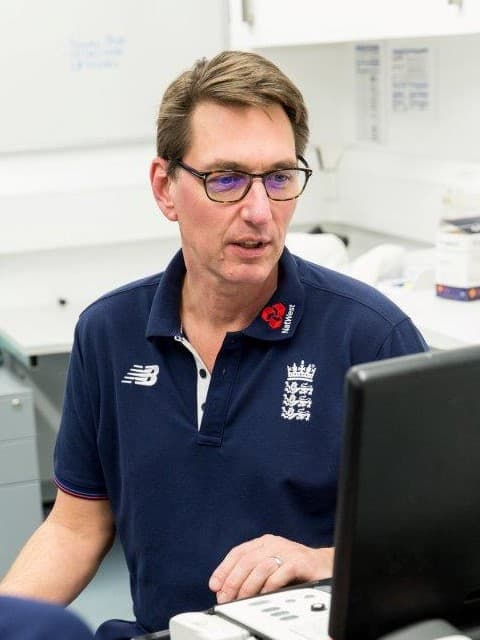
Chief Medical Officer for England and Wales Cricket Board
The Evolving Role of Science, a University and Biomechanics in Elite Sport; England Cricket’s perspective.
England cricket’s National Cricket Centre has been resident at Loughborough University for 25 years and worked closely with multiple stakeholders including Biomechanics, Sports Technology and Human Sciences. This talk will look to describe the work to date and evolving ambitions of science and technology integration. This will provide examples of collaboration in relation to performance and welfare seen across areas including kinematics of -bowling performance, power hitting, injury prevention, protective and playing equipment, surfaces and gender and age development / profiling.

University of Wollongong
“Bridging the gap” between applied biomechanics research and sports:
Are you truly making an impact in sport?
Since the first ISBS conference in San Diego in 1982, the Society’s primary purpose has been to bridge the gap between researchers and practitioners. In the context of applied sports biomechanics research, this means translating theoretical scientific findings into practical strategies that improve sports performance. When successful, these research outcomes enhance performance by: (i) optimising movement techniques, (ii) improving the design of sports equipment (including footwear and clothing), and/or (iii) developing intervention strategies to improve technique or equipment use. In essence, the goal is to turn academic knowledge into actionable solutions that enhance sporting performance. However, while biomechanical results are typically generated in highly controlled laboratory settings, the reality of sports involves dynamic and unpredictable conditions. Consequently, practitioners face persistent challenges in applying scientific insights to training, an essential task as competitive standards rise. This presentation will examine selected applied biomechanics research outcomes and strategies for translating research into sports practice. It will also discuss why some strategies have struggled to meet translational goals and address the ongoing challenges faced by researchers seeking real-world impact. Ultimately, are the outcomes of your applied research truly making a measurable difference in sport?
See below for the route between keynote/registration venue (EHB: Edward Herbert Building) and parralel session / exhibitor venue (James France):
